
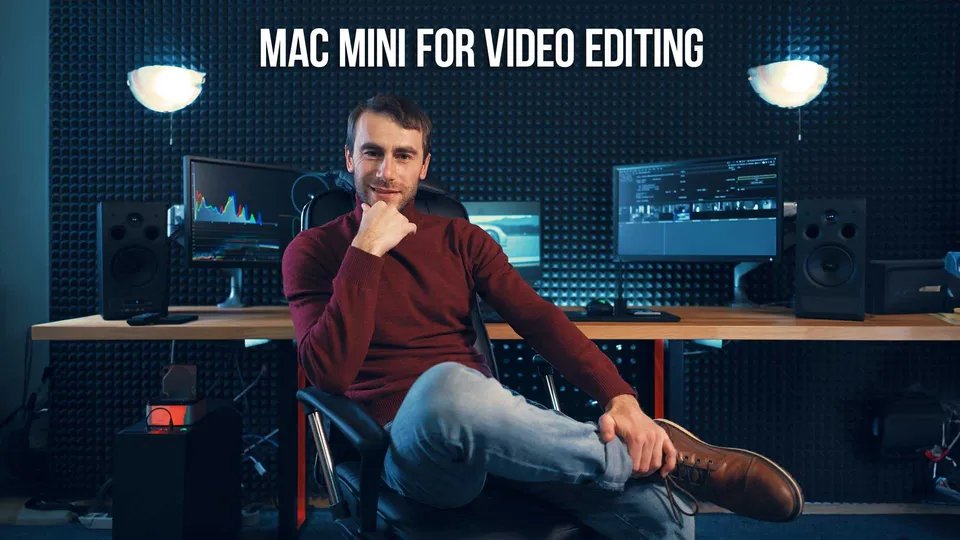
Yes, the current Mac mini is good for video editing. I would buy the M4 model for straightforward 4K work and the M4 Pro when multicam timelines, heavier effects, faster external storage, or longer exports are part of the weekly workload.
Quick answer: For most solo editors, my practical starting point is an M4 Mac mini with 24GB of unified memory and at least 512GB of internal storage. I would move to M4 Pro for demanding Premiere Pro, DaVinci Resolve, After Effects, multicam, noise reduction, or 6K/8K work.
Checked August 10, 2026. Apple currently sells the Mac mini with M4 and M4 Pro chips. Memory and internal storage are configured when you buy and are not normal after-purchase upgrades.
Affiliate disclosure: This page contains affiliate links, and I may earn a commission if you buy through them.
M4 vs M4 Pro for video editing
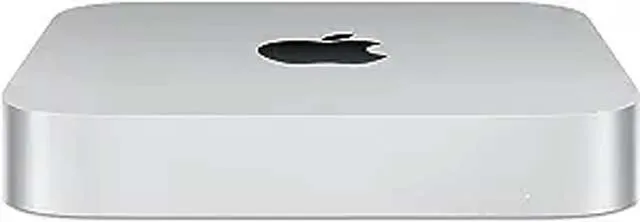
The base M4 is no toy. Apple lists a 10-core CPU, 10-core GPU, hardware acceleration for H.264, HEVC, ProRes, and ProRes RAW, plus AV1 decode. That is a useful media engine for the formats many editors handle every day.
M4 Pro raises the base configuration to a 12-core CPU and 16-core GPU, more than doubles memory bandwidth, and adds Thunderbolt 5. Those differences matter more than a vague “Pro is faster” claim when you are moving large media, stacking effects, or driving a demanding external setup.
| Editing need | M4 Mac mini | M4 Pro Mac mini |
|---|---|---|
| Best fit | YouTube, corporate, interviews, podcasts, and normal 4K timelines | Heavier multicam, effects, color, noise reduction, 6K/8K, and frequent exports |
| Starting memory | 16GB, configurable to 24GB | 24GB, configurable to 48GB |
| Media hardware | H.264, HEVC, ProRes/RAW acceleration and AV1 decode | The same codec support with more CPU, GPU, and memory bandwidth |
| External I/O | Thunderbolt 4 | Thunderbolt 5 |
| My buying read | Best value when the timeline is not overloaded with effects | Worth it when editing time is billable and waiting has a real cost |
I would not buy from the chip name alone. The better question is whether your actual projects are codec-heavy, effect-heavy, memory-heavy, or storage-heavy.
Older M2 Mac mini deal links
Check the exact memory, storage, seller, and warranty before comparing an older model with M4.
See the latest pricing for the M2 Mac Mini on Amazon
See the latest pricing for the M2 Pro Mac Mini on Amazon
See the latest pricing for the M2 Mac Mini at Best Buy
See the latest pricing for the M2 Pro Mac Mini on Best Buy
How much memory and storage should you buy?
16GB is workable; 24GB is the safer long-term choice. Adobe currently recommends 16GB of unified memory on Apple silicon for Premiere, but Premiere is rarely the only app open. Browsers, Photoshop, After Effects, audio tools, review apps, and background exports all share that memory.
For a dedicated Final Cut Pro system with modest projects, 16GB can be enough. For Premiere Pro or Resolve work that includes motion graphics, noise reduction, multicam, large stills, or several apps at once, I would choose 24GB. The 48GB M4 Pro option is for heavier professional work where memory pressure is already familiar.
I would avoid the 256GB internal drive for a serious editing system. It fills quickly once macOS, applications, caches, project files, and downloads accumulate. A 512GB internal SSD is a practical floor; 1TB is more comfortable if you keep active projects and cache files internal.
Use a fast external SSD or storage array for media, but keep the application and cache plan intentional. Adobe's current guidance recommends a fast internal SSD for the app and cache plus another high-speed drive for media.
Neither unified memory nor the internal SSD should be treated as a later upgrade. Choose the memory you expect to need over the machine's working life, then use external storage for capacity that can grow.
Premiere Pro, Final Cut Pro, and DaVinci Resolve
Final Cut Pro: the M4 Mac mini is a strong fit for normal 4K editing, especially with ProRes media and sensible background-render settings. M4 Pro gives more room for multicam, effects, larger projects, and faster turnaround.
Adobe Premiere: Premiere supports Apple silicon, but “compatible” does not mean every project will play perfectly. Codec, effects, plug-ins, color work, memory, cache placement, and storage speed all affect the experience. Adobe's current recommended Mac processor guidance starts at M1 Pro, M1 Max, M1 Ultra, or newer, so I would lean toward M4 Pro for demanding Premiere work.
DaVinci Resolve: Resolve can make good use of Apple silicon, but demanding noise reduction, Fusion compositions, high-resolution timelines, and multiple grades can expose the gap between M4 and M4 Pro. Editors doing that work every day should compare M4 Pro with Mac Studio rather than assuming the least expensive Mac mini configuration is enough.
If Premiere is your main editor, my best Mac for Premiere Pro guide compares the wider Mac lineup.
Ports, displays, and external media
Both current Mac mini versions include front USB-C ports, HDMI, Ethernet, and three rear Thunderbolt ports. The M4 uses Thunderbolt 4; M4 Pro uses Thunderbolt 5. Both can drive up to three displays, although the supported combinations differ.
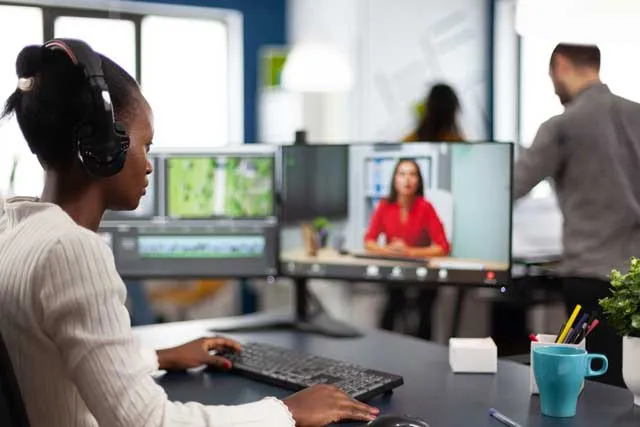
For a single editing monitor plus a second screen and fast external storage, either version can work. M4 Pro is the better fit when you need the extra I/O bandwidth for a fast RAID, capture hardware, multiple high-resolution displays, or several Thunderbolt devices.
Apple offers 10Gb Ethernet as a configure-to-order option. That is worth considering before purchase if you edit from a NAS or expect the workstation to move into a shared-storage workflow.
A practical Mac mini editing setup
The computer is only part of the budget. A useful setup also needs a color-appropriate monitor, keyboard and pointing device, media storage, backups, and—depending on the work—audio monitoring, a card reader, and capture or reference hardware.
- Internal SSD: macOS, editing apps, and cache files.
- Fast external SSD or RAID: active media and project files.
- Separate backup: project copies that are not living on the same working drive.
- Monitor: chosen for the delivery work, not just resolution.
- 10Gb Ethernet: configured at purchase if shared storage is likely.
For display choices, start with my video-editing monitor resources. For storage, prioritize sustained real-world speed and a backup plan over a single impressive peak-speed number.
Where the Mac mini falls short
The biggest limitation is not that the machine is small. It is that the important internal choices are fixed at purchase. You cannot plan on adding unified memory or swapping the internal SSD later like a conventional desktop workstation.
The base M4 also has less memory bandwidth, lower maximum memory, and Thunderbolt 4 instead of Thunderbolt 5. Those limits may never matter for a straightforward 4K YouTube workflow, but they can matter quickly in long-form multicam, heavy After Effects work, advanced Resolve grades, large RAW projects, or shared-storage environments.
The Mac mini also ships without a display, keyboard, or mouse. A low computer price can turn into a larger workstation budget once those pieces and serious storage are included.
When Mac Studio makes more sense
Mac Studio is the next step when you need more GPU capacity, more memory, more media engines, more display support, or sustained performance for workloads that already push a laptop or smaller desktop hard.
I would compare Mac Studio before buying a highly configured M4 Pro Mac mini for daily 8K, complex After Effects or Fusion work, 3D rendering, large multicam sessions, demanding noise reduction, or several high-resolution displays. Apple currently offers Mac Studio with M4 Max or M3 Ultra, depending on the level of work.
One correction to the older version of this guide: Mac Studio memory and internal storage are also configuration-at-purchase decisions. Its advantage is a much higher performance and capacity ceiling, not normal after-purchase RAM or SSD upgrades.
What about an older M2 Mac mini deal?
An M2 or M2 Pro Mac mini can still edit video. I would consider one only when the discount is meaningful, the memory and storage configuration are clear, and the seller's return and warranty terms are acceptable. Do not compare an old clearance price with a current M4 system without also comparing memory, storage, ports, and remaining support life.
My verdict
The M4 Mac mini is a good video-editing computer. For most solo 4K editors, I would choose 24GB of memory and at least 512GB of internal storage, then add fast external media storage.
I would choose M4 Pro when the work includes heavy Premiere projects, multicam, After Effects, Resolve noise reduction, high-resolution media, faster external storage, or frequent exports where time matters. If a high-end M4 Pro configuration starts approaching Mac Studio territory, compare the complete workstation—not just the entry price.
Before buying, verify Apple's current Mac mini specifications, the current Mac mini lineup, and Adobe's current Premiere system requirements.
FAQ
Is the M4 Mac mini good for video editing?
Yes. The M4 Mac mini is a strong option for normal 4K editing in Final Cut Pro, Premiere, and DaVinci Resolve. Memory, storage, codecs, effects, and project complexity still determine how smooth a specific timeline will feel.
Should I buy M4 or M4 Pro for video editing?
Choose M4 for straightforward 4K work and value. Choose M4 Pro for heavier multicam, effects, color, noise reduction, higher-resolution media, faster Thunderbolt storage, or frequent exports.
Is 16GB enough for video editing on a Mac mini?
It can be enough for modest projects, especially in Final Cut Pro. I recommend 24GB for a longer-lived Premiere, Resolve, or multi-app workstation, and 48GB when heavier professional work already creates memory pressure.
Can a Mac mini edit 4K video?
Yes, but there is no honest promise that every 4K project will be effortless. Codec choice, effects, multicam, noise reduction, plug-ins, memory, cache, and storage speed all affect performance.
Can I upgrade Mac mini memory or internal storage later?
Treat both as purchase-time choices. Plan the unified memory for the machine's working life and use external storage to expand media capacity.

About the Author
Joseph Nilo has been working professionally in all aspects of audio and video production for over twenty years. His day-to-day work finds him working as a video editor, 2D and 3D motion graphics designer, voiceover artist and audio engineer, and colorist for corporate projects and feature films.
Video Editing Related Posts
Adobe Creative Cloud for Video Editing
Top 10 Video Editing Software for Mac
The Benefits of Dual-Monitor Setups for Video Editing
How to Choose the Right Video Editing Monitor for Your Needs
Best Monitors for Video Editing
(Almost) 50 Mistakes Every New Video Producer Makes
Breakthrough AI Tools: Elevate Your Video Production Game!
Find the Best Export Settings for YouTube Videos Now!
Your Guide on Where To Find Video Editor Remote Jobs
Adobe video workflow guides