
A 4K camera file is only a few hundred megabytes.
A visually similar ProRes or All-Intra file is several times larger.
The small file should be easier to edit.
Often, it is not.
Storage size tells you how much data is written. It does not tell you how much work is required to reconstruct one frame.
That is the central difference between Long-GOP and All-Intra video.
Quick answer
All-Intra stores every frame as an independently decodable picture. The editor can move directly to a frame without rebuilding a long chain of temporal predictions.
Long-GOP stores complete reference frames plus predicted frames that describe changes over time. It is more storage-efficient, but random access can require several related frames to be decoded.
Use Long-GOP when:
- recording time matters;
- card and archive space are limited;
- the camera’s encoder is strong;
- the editing system has matching hardware acceleration; and
- the project does not require constant exchange or many rendered generations.
Use All-Intra or a frame-independent intermediate when:
- timeline response matters;
- the project is multicam;
- motion is complex;
- every frame must be accessed reliably;
- VFX and compositing are heavy;
- media moves among applications; or
- storage is less important than predictable post performance.
At a glance
| Property | Long-GOP / interframe | All-Intra / intraframe |
|---|---|---|
| Temporal prediction | Yes | No interframe dependency |
| Typical data rate | Lower for similar visual target | Higher |
| Random frame access | May decode surrounding references | Direct per-frame decode |
| Storage efficiency | Strong | Lower |
| Edit behavior | Hardware/profile dependent | Usually predictable |
| Strong fit | Long recording, delivery, efficient capture | Post, multicam, VFX, intermediates |
What a group of pictures is
A group of pictures, or GOP, is an encoded sequence organized around frame dependencies.
A GOP can include:
- independently coded frames;
- frames predicted from earlier pictures;
- frames predicted from earlier and later pictures; and
- metadata describing how the pictures are presented and decoded.
The exact structure depends on the codec, profile, encoder, settings, and scene.
“Long-GOP” is a practical production term, not one universal number of frames.
A GOP might span a fraction of a second or several seconds.
Open and closed GOPs
A closed GOP can be decoded without references outside that group.
An open GOP may use pictures from a neighboring group for additional efficiency.
This matters to:
- seeking;
- cuts;
- segment boundaries;
- error recovery;
- smart rendering; and
- streaming.
Most camera operators do not need to configure open versus closed GOP directly.
Editors should understand that two files labeled H.264 can have different dependency structures.
I, P, and B frames
I-frames
An I-frame is an intra-coded picture.
It can be decoded without using another video frame as a prediction reference.
That does not mean it is uncompressed.
JPEG-like spatial compression, transforms, quantization, and other codec tools can still reduce data inside the frame.
P-frames
A P-frame uses prediction from one or more earlier reference pictures.
Instead of describing the entire image from scratch, it can describe:
- motion;
- changed blocks;
- residual error; and
- new image areas.
B-frames
A B-frame can use information from pictures before and after it in presentation order.
That often improves compression efficiency.
It can also mean decode order and display order differ.
The decoder may need to receive a later reference picture before displaying an earlier B-frame.
Frame type is not quality rank
An I-frame is not automatically a “full-quality frame” while P and B frames are “bad frames.”
A strong encoder distributes bits across the GOP based on image complexity and prediction quality.
A P or B frame can reconstruct cleanly.
A heavily compressed I-frame can contain visible artifacts.
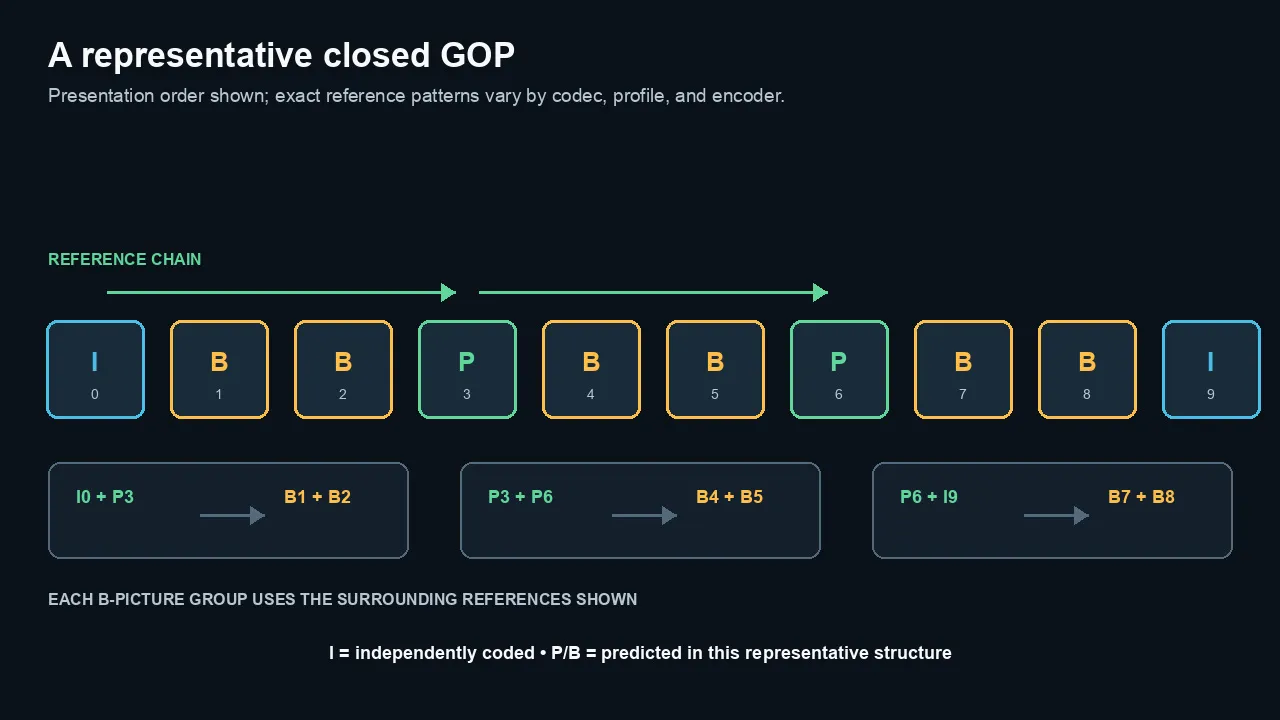
A representative closed GOP: reference pictures support predicted frames, but exact patterns vary by codec, profile, and encoder.
How Long-GOP compression works
Long-GOP codecs exploit temporal redundancy.
If a locked interview background does not change, the encoder does not need to describe every pixel from zero in every frame.
It can reference earlier information and encode the differences.
What Long-GOP does well
- Long recording times
- Small camera files
- Efficient streaming
- Static or predictable scenes
- Modern delivery
- Battery- and storage-sensitive capture
- High resolutions at manageable data rates
What makes Long-GOP demanding
To display one requested frame, the decoder may need to:
- locate the nearest usable reference picture;
- decode that frame;
- decode later predictions in dependency order;
- apply motion vectors and residual data; and
- return the requested display frame.
When the editor scrubs rapidly, moves backward, or displays several camera angles, that work repeats across many positions.
Long-GOP is not one codec
H.264, HEVC, MPEG-2, AV1, and other codecs can use interframe structures.
Some also offer intra-only profiles or settings.
The phrase describes temporal coding, not the entire codec family.
How All-Intra compression works
All-Intra encodes each frame independently.
The codec still uses spatial compression inside the frame.
It simply avoids predictions that require other video frames.
What All-Intra does well
- Frame-accurate access
- Scrubbing and trimming
- Multicam
- VFX and compositing
- Reverse playback
- Frame stepping
- Media interchange
- Repeated renders
- Recovery after damaged frames
What All-Intra costs
It cannot reuse unchanged image information across time.
To maintain a comparable visual target, it usually needs a higher data rate.
That means:
- larger cards;
- faster card write speed;
- more archive storage;
- higher transfer time;
- greater network load; and
- faster sustained disk throughput.
ProRes is frame-independent
Apple’s ProRes white paper describes the ProRes family as frame-independent.
That is one reason ProRes is widely used for acquisition, intermediate renders, and mastering.
Camera All-Intra H.264 or HEVC modes can also provide independent frames, but they retain the other characteristics of those codec implementations.
All-Intra does not turn H.264 into ProRes.
Why small files can be harder to edit
File size and decode cost are separate.
A Long-GOP file saves storage by performing more temporal analysis and reconstruction.
An All-Intra file spends more data so each frame is easier to locate and decode independently.
Scrubbing
When you drag the playhead, the editor requests frames out of normal playback order.
All-Intra can decode the requested frame directly.
Long-GOP may need to rebuild part of a GOP repeatedly.
Reverse playback
Interframe media is normally designed for forward decode dependencies.
Reverse playback can increase seeking and reconstruction work.
Multicam
Four camera angles mean four decoders.
Eight angles mean eight.
A computer that plays one Long-GOP stream smoothly may struggle with several simultaneous streams.
Effects and color
Every frame must be decoded before the effect pipeline begins.
Noise reduction, stabilization, optical flow, scaling, and color management add work after decode.
A decode bottleneck can be mistaken for a GPU-effect problem.
Proxies can separate edit performance from source quality
You do not need to choose All-Intra capture solely to make the edit responsive.
A proxy workflow can preserve efficient camera originals while providing lightweight editing media.
That is often the best answer for long-form or multicam projects.
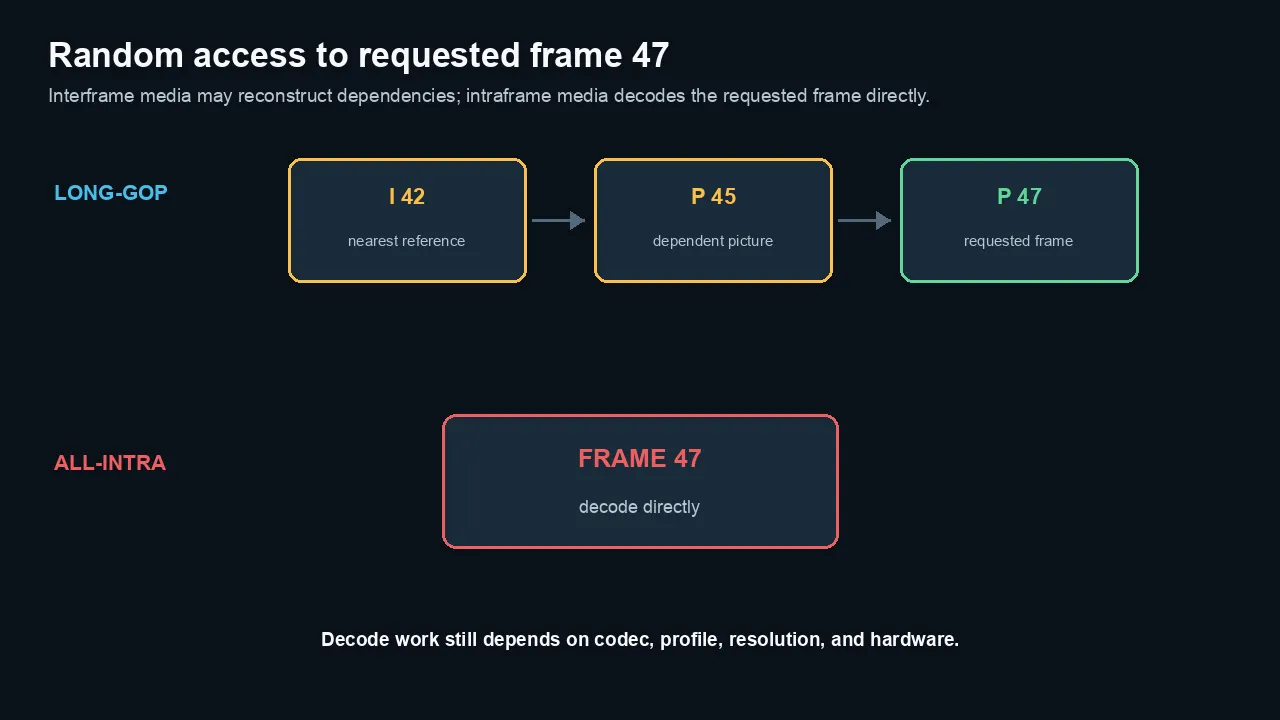
A Long-GOP decoder may reconstruct dependencies before returning frame 47; an intraframe decoder can access that frame directly.
Quality and bitrate
All-Intra is not automatically higher quality.
Long-GOP is not automatically lower quality.
The encoder has a data budget.
At the same bitrate
A capable Long-GOP encoder can spend bits more efficiently by reusing information across frames.
At the same low bitrate, Long-GOP may look better than All-Intra because every All-Intra frame must carry its own complete spatial description.
At camera preset bitrates
Camera manufacturers often assign much higher bitrates to All-Intra modes.
The resulting file may preserve complex motion and frame detail better while remaining easier to edit.
That improvement comes from the entire preset:
- data rate;
- encoder quality;
- bit depth;
- chroma sampling;
- profile;
- frame structure; and
- camera processing.
Do not credit every difference to GOP structure alone.
Constant bitrate is not the same as constant quality
An encoder can use:
- constant bitrate;
- variable bitrate;
- constrained variable bitrate;
- constant-quality modes; or
- camera-specific rate control.
Long-GOP and All-Intra can be paired with different rate-control methods.
Hardware acceleration
Modern media engines can decode Long-GOP codecs efficiently.
When the exact profile is supported, H.264 or HEVC originals may edit smoothly.
Support depends on:
- codec;
- profile;
- level;
- bit depth;
- chroma sampling;
- resolution;
- frame rate;
- operating system;
- NLE; and
- hardware generation.
A common trap: 10-bit 4:2:2 HEVC
A machine may accelerate 8-bit or 10-bit 4:2:0 HEVC but not the camera’s 10-bit 4:2:2 profile.
Software decoding can then become the bottleneck.
Another machine may include dedicated support and play the same file easily.
Storage can reverse the result
All-Intra media needs higher sustained disk throughput.
On a slow drive, the large file can stutter even though each frame is simpler to decode.
A proper test checks both:
- decode capability; and
- storage bandwidth.
Motion, errors, and generations
Complex motion
Water, foliage, confetti, noise, handheld motion, and flashing lights make temporal prediction harder.
A strong Long-GOP encoder can still perform well.
All-Intra can be more predictable because each frame receives its own independent allocation.
The result depends on bitrate and encoder quality.
Error propagation
If an interframe reference picture is damaged or lost, dependent pictures can also be affected until the stream reaches a clean recovery point.
An independently coded frame limits temporal dependency.
In normal file-based camera recording, physical corruption should be rare.
The distinction matters more in transmission, damaged media, and fragile storage.
Repeated generations
Every lossy re-encode can introduce new damage.
Long-GOP intermediates can be especially awkward when a workflow repeatedly decodes, alters, and rebuilds temporal predictions.
For application exchange and multiple generations, use a robust intraframe intermediate such as an appropriate ProRes profile.
Smart rendering
Some applications can copy unmodified encoded sections without recompressing them.
Cuts that do not align with safe GOP boundaries may require partial re-encoding.
Support varies by codec, container, application, and export setting.
Which format should you choose?
Capture Long-GOP when
- recording time is long;
- cards and archive space matter;
- the subject is ordinary live action;
- the camera encoder is proven;
- the NLE hardware supports the profile;
- turnaround does not require constant application exchange; and
- you can create proxies when needed.
Capture All-Intra when
- the camera’s All-Intra implementation is strong;
- motion is complex;
- frame-level access matters;
- the project is multicam but storage is manageable;
- the media will be graded, keyed, or processed heavily;
- post hardware lacks support for the Long-GOP profile; or
- the production values predictable editorial performance over recording time.
Transcode to intraframe when
- the originals remain choppy after basic troubleshooting;
- proxies do not fit the finishing workflow;
- several applications exchange full-resolution renders;
- the camera codec is poorly supported;
- multigeneration quality matters; or
- a stable master/intermediate is required.
Keep Long-GOP for delivery when
- the platform or device expects it;
- storage and bandwidth efficiency matter;
- the file is a final viewing copy; and
- broad compatibility has been verified.
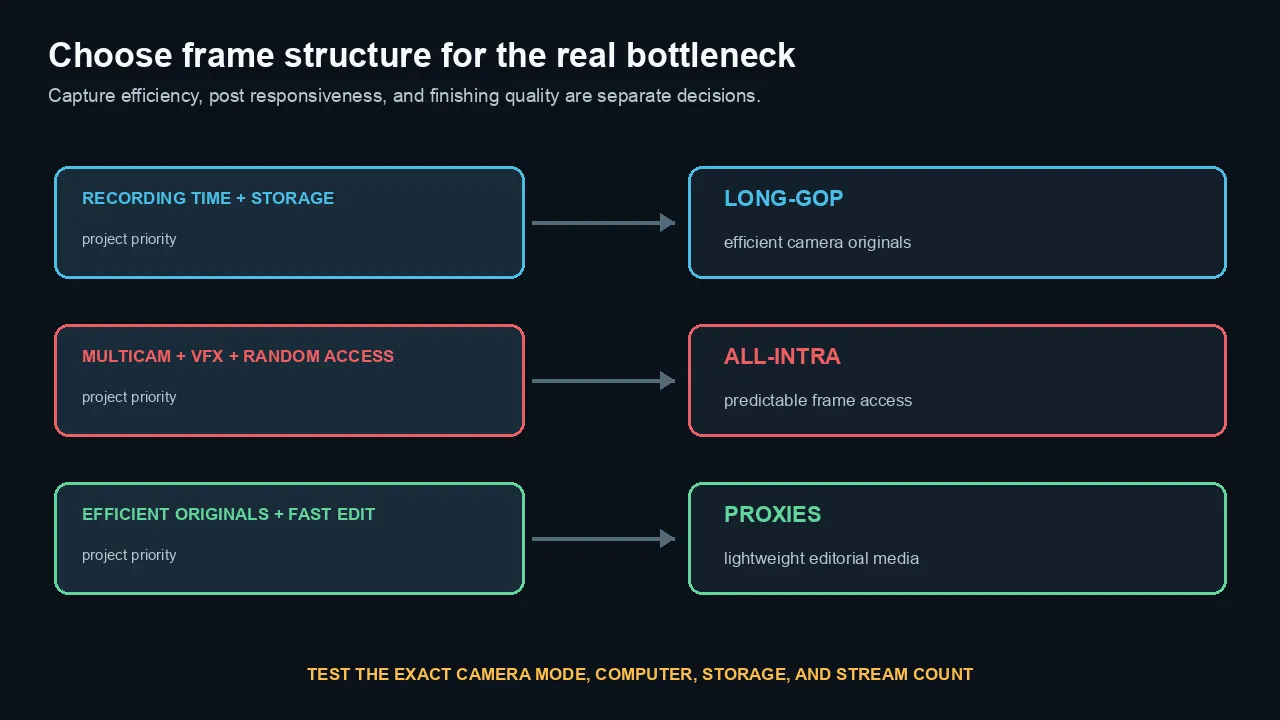
Choose for the bottleneck: Long-GOP for efficient originals, All-Intra for predictable frame access, or proxies for efficient capture plus a responsive edit.
Recommendations by project
Interviews
Long-GOP is often efficient and visually strong.
Use All-Intra when post performance, camera matching, or strong corrections justify it.
Lighting, exposure, focus, bit depth, and chroma sampling may matter more than GOP mode.
Sports and action
Test complex motion.
All-Intra can provide predictable frame access and motion detail at high camera preset bitrates.
Long-GOP can still perform well with a strong encoder and sufficient data rate.
Multicam events
Storage grows quickly with All-Intra across several cameras.
A strong approach is efficient camera originals plus proxies.
Test the real number of streams before the event.
Documentary
Long-GOP saves substantial field and archive space.
Create proxies for editorial work and keep originals for finishing. The same principle supports optimized Final Cut Pro performance.
Green screen and VFX
Bit depth, chroma sampling, noise, and exposure are critical.
All-Intra can make frame access and exchange more predictable, but it does not replace the need for 10-bit 4:2:2 or better when the key demands it.
Software tutorials
Screen recordings may already use Long-GOP or VFR.
Normalize unstable captures to a CFR intraframe intermediate before detailed callouts and captions.
Preserve native screen resolution.
Mastering
Use a high-quality intraframe master.
Do not use a low-bitrate Long-GOP delivery file as the only archival master.
How to inspect and test a format
Inspect metadata
MediaInfo and ffprobe can report codec, profile, bitrate, and frame information. For repeatable batch inspection and transcodes, Adobe Media Encoder can complement this command-line check.
They may not label every GOP mode directly.
Use:
ffprobe -v error \

  -select_streams v:0 \

  -show_entries stream=codec_name,profile,level,pix_fmt,bit_rate,r_frame_rate \

  -show_entries format=format_name,duration,size \

  -of default=noprint_wrappers=1 \

  "input.mov"
Inspect frame types
ffprobe -v error \

  -select_streams v:0 \

  -show_entries frame=best_effort_timestamp_time,pict_type,key_frame \

  -of csv=p=0 \

  "input.mp4"
This reveals I, P, and B picture labels as reported by the decoder.
Do not infer the entire encoder configuration from one short section.
Run a workflow test
Use the same scene and camera settings where possible.
Measure:
- recording time per card;
- file size;
- transfer time;
- sustained drive throughput;
- decode CPU/GPU use;
- dropped frames;
- scrub latency;
- multicam stream count;
- render and export time;
- visible motion artifacts; and
- generation loss.
Keep bit depth, chroma, resolution, frame rate, and picture profile constant if the camera allows it.
Common myths
Myth 1: All-Intra is uncompressed
No.
Each frame is independently compressed.
Myth 2: Long-GOP always looks worse
No.
At a given data rate, temporal prediction can improve compression efficiency.
Myth 3: All-Intra always edits smoothly
No.
The drive must sustain the data rate, and the codec still needs decoding.
Myth 4: Small files are easy to edit
No.
Small files can require complex temporal reconstruction.
Myth 5: H.264 always means Long-GOP
No.
H.264 implementations can use intra-only profiles or camera modes.
Myth 6: ProRes is the same as All-Intra H.264
No.
Both can be frame-independent, but their codec design, profiles, data rates, compatibility, and post behavior differ.
Myth 7: Transcoding to ProRes restores quality
No.
It creates a robust editing representation of the decoded source. It cannot restore missing camera information.
Myth 8: GOP length alone predicts quality
No.
Encoder quality, bitrate, motion, reference structure, bit depth, chroma, and rate control also matter.
The practical bottom line
Long-GOP spends computation to save storage.
All-Intra spends storage to simplify frame access.
Use efficient camera originals when recording time and archive size matter.
Use proxies or a robust intraframe intermediate when post performance becomes the bottleneck.
Do not judge the choice from one specification line. Test the exact camera mode, editing hardware, drive, and project load.
Frequently asked questions
What is the difference between Long-GOP and All-Intra?
Long-GOP uses predictions across frames, while All-Intra compresses every frame independently. Long-GOP is usually more storage-efficient; All-Intra generally provides more predictable frame access for editing.
Is All-Intra better quality than Long-GOP?
Not automatically. At the same low bitrate, Long-GOP may use data more efficiently. Camera All-Intra modes often use much higher bitrates, which can improve results but changes more than frame structure.
Why is Long-GOP harder to edit?
The decoder may need to reconstruct several reference and predicted frames before returning the requested frame. Scrubbing, reverse playback, multicam, and random seeking can increase that work.
Is ProRes All-Intra?
The Apple ProRes family is frame-independent. Each frame can be decoded without temporal prediction from other video frames.
Does H.264 use Long-GOP?
H.264 commonly uses interframe GOP structures for delivery and camera recording, but it can also support intra-only modes and profiles.
Should I record All-Intra for YouTube?
Record it when the production and post workflow benefit from it. YouTube will re-encode the upload, so All-Intra capture does not remain an All-Intra viewing stream.
Is Long-GOP bad for color grading?
Not by definition. Bit depth, chroma sampling, bitrate, noise, and camera processing are more direct grading constraints. Decode performance can affect the editing experience.
Should I transcode Long-GOP footage to ProRes?
Transcode when the originals are slow, poorly supported, or moving through several full-quality post stages. Use proxies when the main need is lightweight editorial performance.
Does All-Intra require faster cards?
Usually, because camera All-Intra modes commonly use higher data rates. Check the manufacturer’s exact card-speed requirement for the selected resolution and frame rate.
Can hardware acceleration make Long-GOP easy to edit?
Yes. A hardware decoder that supports the exact codec profile, bit depth, chroma sampling, resolution, and frame rate can make Long-GOP media highly responsive.
Official sources checked
- Apple ProRes White Paper
https://www.apple.com/final-cut-pro/docs/Apple_ProRes.pdf
- Sony FX3 official specifications and recording-format notes for XAVC S-I, XAVC S, and XAVC HS
- Adobe Premiere hardware-acceleration and supported-format documentation
- FFmpeg codec and frame inspection documentation
https://ffmpeg.org/ffprobe.html

About the Author
Joseph Nilo has been working professionally in all aspects of audio and video production for over twenty years. His day-to-day work finds him working as a video editor, 2D and 3D motion graphics designer, voiceover artist and audio engineer, and colorist for corporate projects and feature films.