
| Quick answer | Adobe Dreamweaver is Adobe's visual web design and code editor for building and managing HTML, CSS, JavaScript, and responsive websites. |
|---|---|
| Best for | Designers who want visual site editing plus code access, legacy Dreamweaver sites, static HTML/CSS work, email/template edits, and people already inside Creative Cloud. |
| Skip if | You need a modern app framework workflow, Git-heavy engineering environment, WordPress block editing, Webflow-style no-code design, or a team IDE setup. |
| Main rule | Dreamweaver is useful for specific web-design workflows, but it is no longer the default recommendation for every website build. |
Adobe Dreamweaver is a website design and coding app that combines a visual editor with direct HTML, CSS, and JavaScript editing.
It still has a place in 2026, but that place is narrower than it used to be.
If you are maintaining a Dreamweaver-era site or want a visual front end for hand-authored web pages, it can be useful. If you are building a modern Django, React, Shopify, or WordPress workflow, it is probably not the center of the stack.
This page may include affiliate links.
I only recommend software I would seriously evaluate for real creator or production workflows.
⭐⭐⭐⭐⭐
I pay for Adobe Creative Cloud and have used it every day in my 20-year career as a video editor, producer, and colorist.
Use the Adobe link below to check the current Creative Cloud offer. It can support this site and helps me keep these guides updated. Check current Adobe Creative Cloud offer.
Get Adobe Creative Cloud Now!
What Adobe Dreamweaver Does
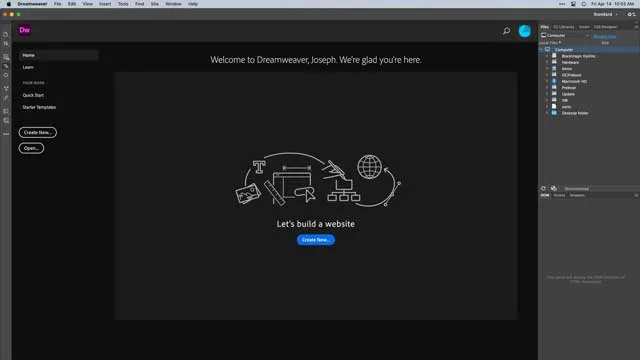
Adobe describes Dreamweaver as software for designing and developing modern responsive websites. It includes code editing, visual design tools, site management, templates, and live preview workflows.
The main appeal is that you can work visually while still editing the actual code. That is different from a pure code editor and different from a fully hosted site builder.
Best Uses for Dreamweaver Today
- Legacy websites: maintain older sites that were built around Dreamweaver templates or static files.
- Static HTML/CSS pages: edit pages where a lightweight visual workflow helps.
- Designer-code bridge: give visual designers access to HTML and CSS without a full engineering IDE.
- Template edits: update straightforward HTML templates, landing pages, and marketing assets.
- Creative Cloud fit: use web assets from Photoshop, Illustrator, and Creative Cloud Libraries.
For content creators, Dreamweaver is most relevant when you need to maintain direct control over HTML/CSS rather than use a CMS editor.
Dreamweaver vs. Modern Web Tools
Dreamweaver sits in an unusual spot now. It is more visual than a code editor, but less productized than modern no-code site builders.
| Need | Dreamweaver fit | Better option |
|---|---|---|
| Maintain old static pages | Good fit | Dreamweaver may be practical if the site is already built that way. |
| Build a modern app | Weak fit | Use the app's normal framework tooling and code editor. |
| No-code marketing site | Limited fit | Use Webflow, Framer, Squarespace, or a CMS builder if you want hosted no-code. |
| WordPress publishing | Usually not needed | Use WordPress/Wagtail/CMS templates and the admin/editor workflow. |
| HTML email or small template edits | Possible fit | Dreamweaver can work if the templates are straightforward. |
For most professional engineering teams, Dreamweaver is not the main development environment. For specific design-led HTML workflows, it can still be useful.
Where Dreamweaver Fits in Creative Cloud
Dreamweaver is most useful when the website work connects to other Adobe assets. Think graphics from Illustrator, images from Photoshop, brand assets in Creative Cloud Libraries, and web layouts that need direct HTML/CSS control.
It is not a replacement for Illustrator, Photoshop, Adobe Express, or a CMS. It is the web page assembly and code-editing layer for a narrower set of projects.
Should You Learn Dreamweaver in 2026?
If you are starting web design from scratch, I would learn HTML, CSS, responsive layout, accessibility basics, and the tools used in the environment you actually plan to work in.
Dreamweaver can still help you understand the connection between visual layout and code, but it should not be your only web skill.
Where to Go Next
If you are working inside Creative Cloud, read what Illustrator is for, how Creative Cloud Libraries work, and what Adobe Express is for.
For Adobe's current positioning, use the official Adobe Dreamweaver product page.
FAQ
What is Adobe Dreamweaver used for?
Dreamweaver is used to design, code, preview, and manage websites using HTML, CSS, JavaScript, and responsive web design tools.
Is Dreamweaver still useful?
Yes, for specific workflows such as maintaining older static sites, editing HTML/CSS visually, and managing straightforward website files. It is less useful as the default tool for modern app development.
Is Dreamweaver good for beginners?
It can help beginners connect visual layout with code, but beginners should still learn HTML, CSS, responsive design, accessibility, and modern publishing workflows.
Is Dreamweaver a no-code website builder?
No. Dreamweaver has visual design tools, but it is still tied to real website code and file management.
Does Dreamweaver come with Creative Cloud?
Dreamweaver is available through Adobe plans, including Creative Cloud options. Check Adobe's current plan page for availability and pricing.

About the Author
Joseph Nilo has been working professionally in all aspects of audio and video production for over twenty years. His day-to-day work finds him working as a video editor, 2D and 3D motion graphics designer, voiceover artist and audio engineer, and colorist for corporate projects and feature films.
Related Posts:
Adobe Creative Cloud What Is Series
Adobe Creative Cloud Pricing Explained
Adobe Creative Cloud Pricing and Plans - The Ultimate Resource
Best Adobe Creative Cloud Apps for Graphic Design
How to Install Adobe Creative Cloud on Mac
Adobe Creative Cloud for Photographers
Adobe Creative Cloud for Video Editing
How to Use Adobe Creative Cloud Libraries
Adobe Creative Cloud Subscription Discount
Adobe Creative Cloud Student Discount
Adobe creator and buying paths
Adobe Creative Cloud for Video Creators
Adobe Photography Plan vs Photoshop Single App
Best Adobe Creative Cloud Apps for YouTubers
Adobe Express for YouTube Thumbnails
Adobe Stock Licensing for YouTube and Client Work
Adobe app explainers and storage
What Is Adobe Photoshop Elements?
What Is Adobe Premiere Elements?
What Is Adobe Character Animator?
Adobe Rush migration paths
Premiere Rush Discontinuation FAQ
Adobe Creative Cloud "What Is" Series:
What is Adobe Character Animator?
What is the Creative Cloud App?
What Is Adobe Photoshop Elements?
What Is Adobe Premiere Elements?
More Adobe app explainers