

Updated August 4, 2026
The best Adobe app for graphic design is Illustrator when the work must stay vector, Photoshop when the design depends on pixels and compositing, and InDesign when typography and multi-page layout control the job. Adobe Express, Firefly Boards, and Fresco now fill important speed, ideation, and drawing roles around that core.
You do not need every Adobe app open for every project. The useful question is which application should own each stage: direction, asset creation, photo work, layout, review, and delivery. This guide maps the current Adobe lineup to real design jobs, including the newer tools that older Creative Cloud lists often miss.
Quick answer
- Logos, icons, packaging, and scalable art: Illustrator.
- Photo-led campaigns, mockups, and compositing: Photoshop.
- Books, reports, brochures, and print layouts: InDesign.
- Fast social graphics and team variations: Adobe Express.
- Moodboards, AI exploration, and visual direction: Firefly Boards.
- Stylus-first drawing and painting: Fresco.
My default professional stack is Illustrator + Photoshop + InDesign. Add Express when other people need safe variations, and use Firefly Boards before production when the visual direction is still moving.
This page may include affiliate links.
I only recommend software I would seriously evaluate for real creator or production workflows.
⭐⭐⭐⭐⭐
I pay for Adobe Creative Cloud and have used it every day in my 20-year career as a video editor, producer, and colorist.
Use the Adobe link below to check the current Creative Cloud offer. It can support this site and helps me keep these guides updated. Check current Adobe Creative Cloud offer.
Get Adobe Creative Cloud Now!Adobe graphic design app map
Adobe's current product catalog spans desktop, web, and mobile tools. The overlap is intentional, but the apps are not interchangeable. A precise vector logo, a retouched campaign image, a 60-page report, and a same-day Instagram story need different editing models.
| Design task | Best Adobe app | Why it fits |
|---|---|---|
| Logos, icons, SVGs, vector illustration | Illustrator | Editable paths, artboards, type, color, and controlled export |
| Photo editing, compositing, mockups | Photoshop | Layers, masks, selections, retouching, and pixel-level control |
| Books, reports, brochures, editorial layout | InDesign | Styles, master structure, preflight, typography, and multi-page output |
| Social posts, quick flyers, repeatable variations | Adobe Express | Templates, brand assets, resize, and accessible web/mobile editing |
| Moodboards and visual exploration | Firefly Boards | Infinite canvas, references, generation, remixing, and collaboration |
| Drawing and painting | Fresco | Touch, stylus, live brushes, vector and raster marks |
| Photo libraries and color work | Lightroom | Catalog, batch adjustments, RAW workflow, and synchronized edits |
| Asset browsing and file review | Bridge | Metadata, previews, filtering, and batch organization |
Start with the deliverable, not the app list. If the client needs editable SVG icons, Illustrator should own the source even if Photoshop helps with references. If the client needs a press-ready annual report, InDesign should own the document even if Illustrator supplies charts and Photoshop supplies images.
Illustrator, Photoshop, and InDesign: the core design trio
Illustrator for vector systems
Illustrator is the anchor for logos, identity systems, icons, diagrams, packaging, signage, patterns, and web graphics that must scale cleanly. Its artboards make it practical to manage families of deliverables in one file, while paths, strokes, fills, symbols, type, and export settings keep the result editable.
Adobe's June 2026 Illustrator release added faster relinking and expanded alignment-and-spacing shortcuts, while recent releases also introduced Concept to Vector, Rewrite, Prompt to Edit, and stronger connections to Firefly Boards. Those additions make exploration faster, but the reason to choose Illustrator is still production control. See the separate Illustrator price guide when the plan decision is the blocker.
Photoshop for pixel design and compositing
Photoshop is the better home for photo-led campaigns, realistic mockups, image repair, selections, masks, textures, and layered composites. Adobe's current feature set includes newer generative and organizational tools, but strong Photoshop work still depends on clean layers, deliberate masks, color discipline, and nondestructive edits.
If a design begins with a photograph and ends as a web banner, poster image, or product composite, Photoshop will usually do more of the heavy lifting than Illustrator. The Photoshop price guide compares the practical buying routes.
InDesign for layout systems
InDesign takes over when pages, typography, styles, grids, preflight, linked assets, and print or digital publishing become the system. It is the right owner for books, reports, catalogs, brochures, long proposals, and document families. Adobe's 2026 releases added Rewrite, Flex Layout improvements, PDF-to-InDesign conversion, accessible alt-text help, and in-app Express editing, but the core advantage remains repeatable page structure.
Design the logo in Illustrator, clean the photos in Photoshop, and place both as linked assets in InDesign. That handoff is more stable than rebuilding every asset inside the layout file. The InDesign price guide covers the subscription choice.
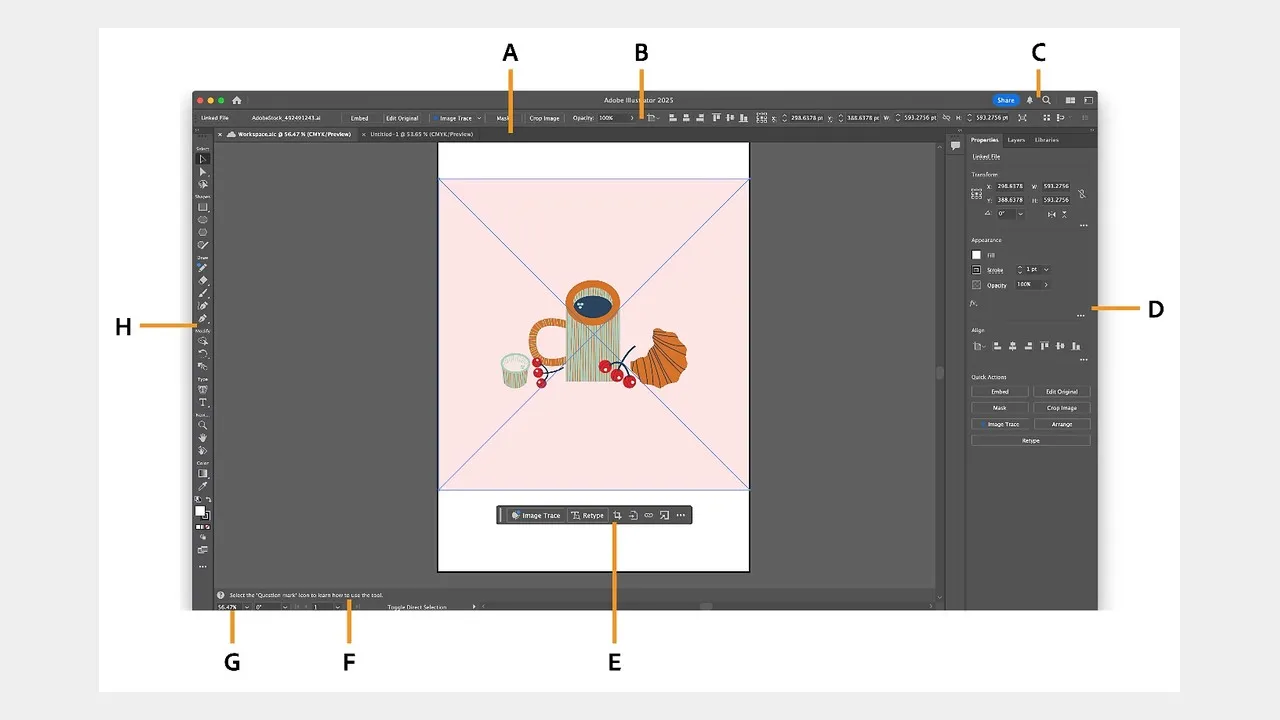
Adobe's current Illustrator workspace guide identifies the document window, toolbar, Properties panel, Contextual Task Bar, and other production controls. Source: Adobe. Interface shown as documented by Adobe and may change.
Adobe Express for fast design and safe variations
Adobe Express is the better tool when speed, templates, browser access, and repeatable variations matter more than deep vector or page-layout control. It can handle social graphics, flyers, simple presentations, short videos, lightweight photo editing, resize tasks, and brand-controlled assets without asking every contributor to become an Illustrator expert.
That makes Express useful after the core design is approved. A designer can establish the visual system in Illustrator, Photoshop, or InDesign, then move approved ingredients into an Express workflow for quick local versions. The product is available on web and mobile, which also makes it easier for marketers or clients to handle constrained edits.
Express is not a universal replacement for the core trio. It is strongest for rapid communication, not complex vector construction, long-document typography, advanced compositing, or specialized prepress. Compare its purchase paths in the Adobe Express price guide.

Adobe Express combines templates, photos, design assets, quick editing, and brand-friendly variations in a lighter web and mobile workflow. Source: Adobe. Interface shown as documented by Adobe and may change.
Firefly and Firefly Boards for visual direction
Firefly is no longer just a text-to-image page beside Creative Cloud. Adobe now groups image, video, audio, and vector generation around Firefly, while Firefly Boards provides an infinite visual workspace for references, moodboards, storyboards, generation, remixing, and collaboration.
Boards is especially relevant to graphic designers because it sits before the production file. A team can collect references, compare directions, generate variations, arrange artboards, and agree on a visual language before the designer commits hours to polished Illustrator or Photoshop work. Adobe also documents handoff paths to Creative Cloud apps.
Use Boards for direction, not for pretending the direction is finished. Check source rights, model terms, brand consistency, anatomy, typography, artifacts, and client approval before generated work becomes a deliverable. The separate Firefly mobile guide covers the newer phone workflow, and the Firefly AI Assistant guide tracks Adobe's conversational layer.
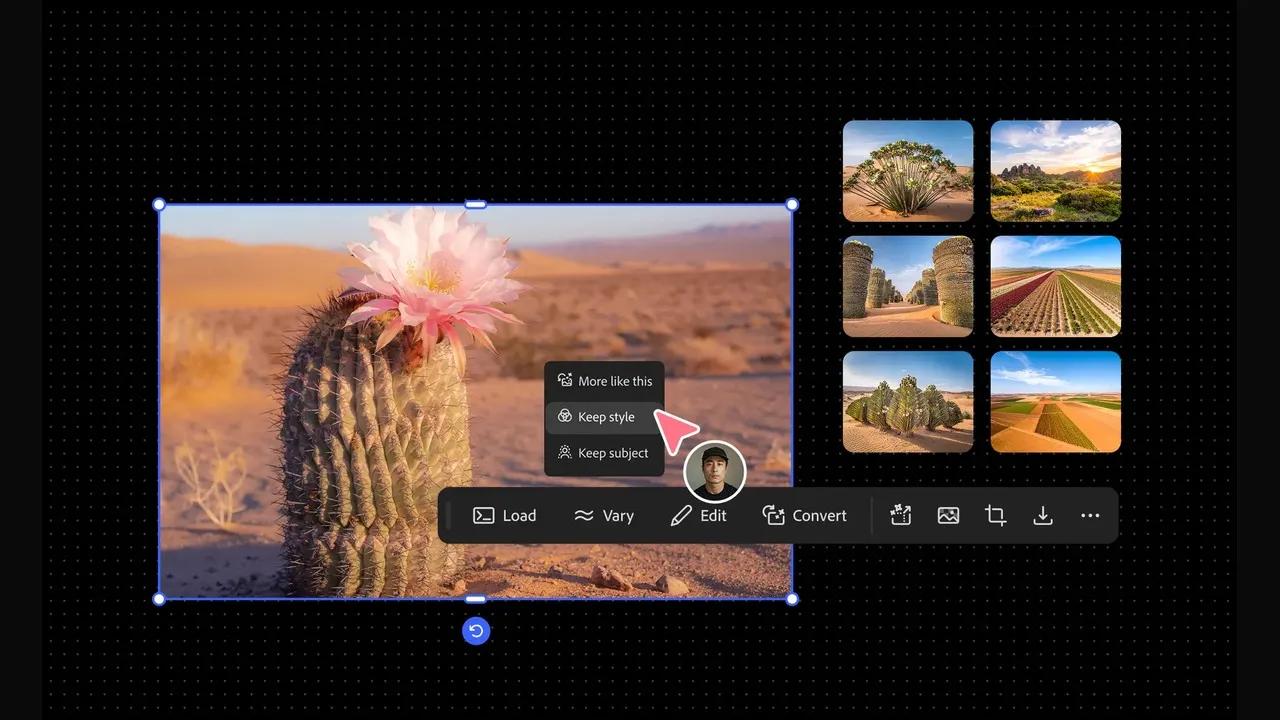
Firefly Boards is Adobe's visual exploration layer for collecting references, generating variations, and shaping a creative direction before production. Source: Adobe. Interface shown as documented by Adobe and may change.
Adobe Fresco for drawing and painting
Fresco is Adobe's touch-and-stylus drawing app for artists who want natural brushes, direct marks, and a less technical starting point than Illustrator. Adobe describes it as combining vector and raster content and highlights live brushes that simulate watercolor and oil behavior. The current app is available on iPhone, iPad, and Windows.
Fresco is a good fit for hand-drawn illustration, concept sketches, expressive lettering, textures, and artwork that will continue into Photoshop or Illustrator. Illustrator remains better for exact logos, diagrams, path cleanup, and production vectors. Photoshop remains better for deep pixel compositing and retouching.
The cleanest workflow is to sketch where the hand feels natural, then finish where the deliverable demands precision. Preserve the original Fresco document and export a controlled handoff rather than flattening the only editable source.
Supporting Adobe apps graphic designers should know
Lightroom and Bridge
Lightroom is a photo-library and adjustment system. It is useful when a campaign begins with hundreds of RAW images that need selection, consistent color, batch treatment, and synchronized edits before the final choices move to Photoshop. Bridge is broader file browsing and metadata management for mixed project folders. The Adobe Bridge guide explains where it fits.
Acrobat Pro
Acrobat Pro matters at the delivery and review end: commenting, comparing, organizing, checking, and preparing PDFs. It does not replace InDesign's source layout or a print provider's preflight process, but it is often the shared review surface after export. See what Acrobat Pro does before adding another subscription.
Adobe Stock AI Studio
Adobe Stock now combines a large licensed-asset library with AI-assisted editing and generation in AI Studio. That can shorten the distance between finding a nearly right image and producing a useful direction. Licensing still matters: record the asset, project, license type, date, and account, and review partner-model terms when a non-Adobe model is involved. The Adobe Stock licensing guide covers the practical recordkeeping.
After Effects and Premiere
Motion deliverables often begin as Illustrator or Photoshop files. After Effects is the better destination for animated type, vector artwork, compositing, and motion systems. Premiere is the better destination for edited video, sequences, and final program delivery. Designers do not need either app for a static identity system, but both become important when a brand must move.
Adobe XD in 2026: legacy, not a new recommendation
Older lists of Adobe graphic-design apps often put XD beside Illustrator and Photoshop. That is useful historical context, but it is not where I would send a new designer in 2026. Existing teams may still need XD to open, maintain, export, or migrate legacy interface-design files.
For a new product-design system, evaluate a currently supported collaborative UI tool around components, variables, prototypes, developer handoff, and team governance. If an XD archive matters, inventory the files and linked assets before changing the workflow. Do not wait for an urgent client revision to discover that the source is trapped in an aging process.
Best Adobe app stacks by graphic design workflow
| Workflow | Recommended Adobe stack |
|---|---|
| Brand identity | Illustrator + Photoshop + InDesign + Libraries |
| Social content team | Photoshop or Illustrator + Adobe Express + Libraries |
| Editorial and reports | InDesign + Photoshop + Illustrator + Acrobat Pro |
| Digital illustration | Fresco + Illustrator + Photoshop |
| Campaign concepting | Firefly Boards + Photoshop + Illustrator + Adobe Stock |
| Motion brand system | Illustrator + Photoshop + After Effects + Premiere |
| Photo-heavy campaign | Lightroom + Photoshop + InDesign or Express |
A stack should remove handoff friction, not reward collecting apps. Pick one representative project and track where files are duplicated, flattened, relinked, or rebuilt. If Express prevents ten uncontrolled social variations, it is useful. If Firefly Boards reduces a week of vague visual feedback, it is useful. If an app stays installed but never owns a stage, remove it from the buying logic.
How to choose the right Adobe plan
Start with the narrowest plan that covers the production owner. A designer who lives in Illustrator and hands off simple exports may be well served by the single-app plan. A brand designer who moves through Illustrator, Photoshop, InDesign, Acrobat, Express, and Firefly has a much stronger case for Creative Cloud Pro.
Compare the regular renewal rate, not only the introductory offer. Check which services, cloud storage, generative credits, and web or mobile access are included in the exact plan and region. The Adobe cloud storage guide explains why storage should not be treated as the only project backup.
Before subscribing, run a real deliverable through the trial: collect references, create vector art, clean an image, build a layout, export a review PDF, and make one fast variation. Test the fonts, formats, linked assets, collaborators, and output that actually earn money.
Official Adobe sources
Frequently Asked Questions
What is the best Adobe app for graphic design?
Illustrator is the best general choice for logos, icons, scalable graphics, and vector systems. Photoshop is better for photo-led design and compositing, while InDesign is better for typography and multi-page layouts.
Which Adobe apps do professional graphic designers use most?
Illustrator, Photoshop, and InDesign remain the core professional trio. Express, Firefly Boards, Fresco, Lightroom, Bridge, Acrobat Pro, After Effects, and Adobe Stock become useful for specific stages.
Is Adobe Express enough for graphic design?
Adobe Express can be enough for template-led social graphics, flyers, quick variations, and simple brand content. It is not a complete replacement for Illustrator paths, Photoshop compositing, or InDesign document systems.
Is Firefly Boards a graphic design app?
It is best treated as an ideation and visual-direction workspace. Designers can collect references, build moodboards, generate variations, and collaborate before finishing production work in Illustrator, Photoshop, Express, or another specialist app.
Should a graphic designer learn Fresco or Illustrator?
Learn Fresco when drawing feel, brushes, and touch or stylus input are central. Learn Illustrator when exact paths, logos, scalable graphics, SVGs, and production vectors are central. Many illustrators use both.
Is Adobe XD still worth learning in 2026?
XD can still matter for maintaining or migrating legacy files, but I would not make it the foundation of a new UI design workflow. Evaluate a currently supported collaborative product-design tool for new systems.
Do graphic designers need Creative Cloud Pro?
Not always. A single-app plan can make sense when one application owns nearly all paid work. Creative Cloud Pro becomes easier to justify when projects repeatedly cross Illustrator, Photoshop, InDesign, Acrobat, Express, Firefly, or motion tools.
Can Adobe apps share files and assets?
Yes. Creative Cloud Libraries, linked assets, cloud documents, and application-specific handoffs can connect workflows, but compatibility and feature depth vary. Test the exact files, fonts, exports, and collaborators required for your work.

About the Author
Joseph Nilo has been working professionally in all aspects of audio and video production for over twenty years. His day-to-day work finds him working as a video editor, 2D and 3D motion graphics designer, voiceover artist and audio engineer, and colorist for corporate projects and feature films.