

JJP Guitars combines a common dynamics/EQ section with seven illustrated parallel returns and a separate Master output. Its four Types—Clean, Rock, R&B/Amb and Chug—provide source-oriented starting settings.
Think of it as a compact mixing console, not a row of seven effects that the guitar must pass through in order. Main adjusts the direct branch; the Center faders blend additional processing alongside it.
This guide follows the complete official manual and authentic panel. I have not auditioned the processor or tested an installation; the artist's sonic descriptions are not listening findings from this article.
My Short Version
Type selects the starting context. Its name is not a published description of a complete hidden signal chain.
Sensitivity feeds the processing; Master controls the combined result. Their jobs are not interchangeable.
Main and the seven returns are parallel contributions. Their sends are taken before the Main fader.
Phase is documented; Pan is component-dependent. Pan belongs to mono-to-stereo, while the pictured Stereo panel legitimately omits it.
Best for and when to choose another tool
Best for: source-oriented guitar shaping when you want broad common controls and processed-return balances in one panel.
JJP's introduction describes a sound-design approach to brighter, darker, more aggressive or sustained guitar treatments. Those intentions are not a promise that a particular Type or fader position produces the same result on every source.
Choose another tool when: you need independent EQ frequencies/Q, exact compressor timing, or fully specified modulation and reverb parameters.
This guide does not establish an amp/cabinet model, a microphone selector or an editable seven-effect rack behind the labels.
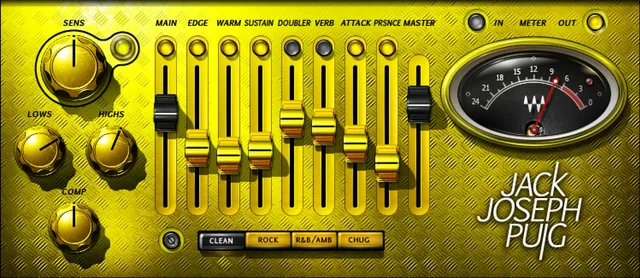
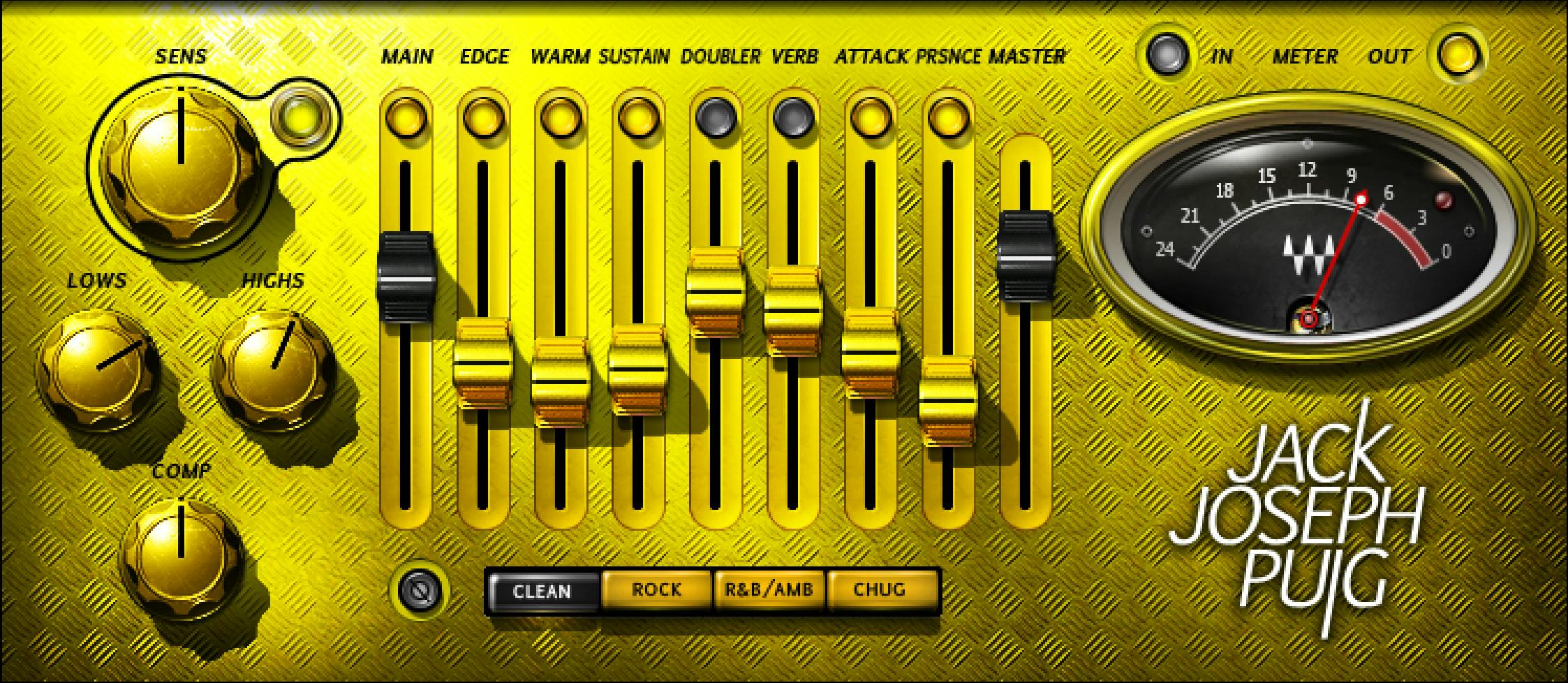
Components, Pan and Phase
The guide lists JJP Guitars m>s, with mono input and stereo output, and JJP Guitars Stereo, with stereo input and stereo output.
m>s means mono-to-stereo, not Mid/Side. No separate mono-to-mono component is documented.
Pan is available in mono-to-stereo. The source does not supply a numeric Pan range, pan law or default. The official Stereo original therefore has no Pan knob.
Phase is a reversal switch documented for JJP Guitars. It is not described as a continuously variable phase-angle control.
The manual does not state a Phase default or establish an automatic phase-alignment function. Its switch is a separate decision from selecting a Type or output level.
Four Types and what they establish
The selector offers Clean, Rock, R&B/Amb and Chug.
Waves says JJP optimized defaults for each Type. Its quickstart recommends choosing the Type for the source before setting Sensitivity and adjusting the Main and Center sections.
Some faders may change with Type. The guide does not provide a full alternate-label matrix, numerical default table or a rule that every control resets when switching.
A Type is a useful starting category, not a documented genre requirement or a guarantee of a specific guitar sound.
Sensitivity: use the loudest material
The SENS control and its LED help establish how the signal reaches the processor. The guide recommends using the section with the highest peaks.
Its descriptions are Off: too low; green: good; yellow: optimal; red: very hot.
The quickstart targets yellow, but the detailed Guitars section expressly allows good results without that indication. The recommendation is guidance, not a requirement to force every passage into one color.
No numeric Sensitivity range, color threshold or calibrated headroom reference is supplied. The LED is distinct from the output Clip light and does not guarantee clipping protection.
Lows, Highs and Comp: the shared Main treatment
LOWS and HIGHS provide the Main Section's broad low- and high-frequency shaping. COMP controls its basic dynamics treatment.
The guide says all processing is influenced by this section. This common treatment occurs before the direct/return split rather than belonging exclusively to one return.
It does not publish EQ frequencies, filter types, Q values or gain ranges. Comp likewise has no separately documented threshold, ratio, attack or release settings here.
A knob position is therefore not a missing decibel or timing specification. The panel offers broad adjustment rather than those independent technical parameters.
Main, pre-fader feeds and Master
The common Main Section splits into a direct branch through Main and additional processed return branches.
Their feeds are pre-Main-fader. The returns then join the direct branch before Master, which controls the combined output.
Lowering Main changes the direct contribution relative to the returns. It does not turn down their pre-fader feeds as though Main were the entire processor's output control.
The authentic panel also shows a round button above Main. Its complete switching and color-state behavior is not separately defined in the guide; it is not evidence of a global bypass or a reset function.
Neither Main nor Master has a published numeric range or default in this manual.
Seven Center returns, each with a mute
The illustrated panel has EDGE, WARM, SUSTAIN, DOUBLER, VERB, ATTACK and PRSNCE.
Each fader controls its own additional processed return, with a dedicated mute button above it. These are return balances, not seven exposed sets of detailed effect parameters.
| Return | What the source supports—and does not specify |
|---|---|
| EDGE | A separately blended processed contribution; no calibrated distortion scale or clipping threshold is supplied. |
| WARM | Its own parallel return, not a documented low-shelf frequency or gain law. |
| SUSTAIN | A return level; no independent release-time or sustain-duration scale is published. |
| DOUBLER | A named return without exposed voice-count, detune or delay specifications in this guide. |
| VERB | A return without a published room model, decay or predelay control. |
| ATTACK | A return balance, not a millisecond compressor-attack setting. |
| PRSNCE | The panel's abbreviated presence label; no center frequency, Q or gain range is stated. |
The labels help identify what you are balancing. They should not be expanded into undocumented algorithms or units.
The guide says some faders can change with Type. This inventory describes the authentic pictured panel, not every alternate Type state.
Why the flow diagram has four blocks
Page 8 draws four generic Process/Fader branches to explain parallel routing. The real Guitars panel has seven visible return faders.
The drawing does not establish a four-effect maximum, eliminate three controls or specify a serial chain.
The useful relationship is consistent with the prose: common Main processing feeds the direct branch and pre-fader auxiliary branches, which sum before Master.
For comparison decisions, keep each return's mute separate from its fader, and keep the Main/direct balance separate from the combined output level.
IN/OUT meter and Clip
IN/OUT switches meter monitoring between input and output.
The manual says Clip lights when levels reach 0 dBFS. Click the indicator to reset it.
The quickstart recommends lowering the output level if Clip repeatedly appears or stays lit. Master is the documented combined-output level control.
No automatic limiting, protection ceiling, acoustic monitoring calibration or detailed meter-ballistics specification is provided. A meter-view change does not itself change gain.
Toolbar and a practical evaluation sequence
The WaveSystem toolbar provides preset save/load, setting comparison, undo/redo, resizing and access to the WaveSystem Guide.
It is illustrated in the manual but cropped from the Library's full-size panel original. The crop does not establish removal of those shared utilities.
Choose the appropriate component and Type. Use the loudest material for Sensitivity, then shape the common Lows/Highs/Comp treatment.
Balance Main against the return contributions. Compare individual returns with their mutes, adjust Master separately, and recheck output metering.
That is a conceptual sequence, not a tested preset. No numeric setting here is presented as universally appropriate or level-matched.
Related Waves guides
The Renaissance Compressor guide explains separate dynamics controls when the broad Comp approach is not the task. The F6 guide covers frequency-selective processing beyond the two broad tone knobs.
For independent output-level and loudness analysis, see the WLM Plus guide.
The Waves Audio Post Resources hub collects other live articles. Subscription versus perpetual licensing is separate from this control guide.
Sources and documentation limits
Checked October 19, 2026, America/New_York. The official JJP Guitars product page links the complete eight-page user guide, read in full.
Page 4 defines components; pages 5–6 define Types and panel sections; pages 7–8 cover controls, routing, metering and utilities. The authentic Graphic Library panel establishes the seven illustrated return labels.
No exact return algorithms, numeric knob/fader ranges/defaults, full Type mapping or measured compatibility/audio result is established. The four-block schematic is not a literal inventory of the seven returns.
FAQ
What does JJP Guitars do?
JJP Guitars combines common dynamics/EQ controls with a direct Main branch and parallel processed returns. Its four Types are source-oriented starting settings, and its illustrated Center section has seven faders. This is a compact mixing-console approach, not a documented serial chain of seven fully adjustable effects or an amp-and-cabinet model with published internal parameters.
Which Types are available?
The four Types are Clean, Rock, R&B/Amb and Chug. The guide says JJP optimized their defaults and that some faders may change by Type. It does not supply a complete numeric initialization table, every alternate return label or a rule that choosing a Type resets all controls. The names are starting categories, not a guarantee for a particular recording.
Which components include Pan and Phase?
The guide lists mono-to-stereo and stereo-to-stereo components. Pan is specifically available in mono-to-stereo. Phase reversal is documented for JJP Guitars without that Pan-only condition. The source does not define continuously variable phase, a Pan law or their numeric defaults. The m>s label means mono input to stereo output, not Mid/Side.
Must the Sensitivity LED always be yellow?
The quickstart targets yellow using the part with the highest peaks. The detailed Guitars guide also explicitly says good results can occur without the optimal yellow indication. Its states are Off for too low, green for good, yellow for optimal and red for very hot. No numeric thresholds or clipping-protection guarantee are supplied.
How are Main and Master different?
Main adjusts the direct branch after the common Main Section. Additional processed returns are fed before that fader, then summed with its branch before Master. Master controls the combined output. Reducing Main changes the direct-to-return balance; it does not turn down the pre-fader feeds in the same way as reducing the combined Master level.
Why are there seven return faders but four blocks in the flow diagram?
The actual panel has EDGE, WARM, SUSTAIN, DOUBLER, VERB, ATTACK and PRSNCE, each with a dedicated mute. The manual's four generic Process/Fader blocks illustrate the parallel architecture. They are not an exhaustive count of Guitars' visible returns, a four-effect runtime limit or evidence of a serial processing order.
Does ATTACK set compressor attack time, and are ranges documented?
The guide defines the Center faders as levels for additional processed returns. It does not give ATTACK a millisecond scale or publish exact algorithms, numeric ranges or defaults for those returns. It also does not provide detailed Lows/Highs filter specifications or Comp threshold, ratio and timing. Return names should not be converted into missing technical parameters.
What does the Clip light report?
The Guitars manual says Clip lights when levels reach 0 dBFS, and clicking it resets it. IN/OUT changes meter monitoring between input and output. The quickstart recommends lowering output if Clip repeatedly appears or stays lit. No automatic limiter, guaranteed clipping prevention or calibrated acoustic monitoring level is documented.

About the Author
Joseph Nilo has been working professionally in all aspects of audio and video production for over twenty years. His day-to-day work finds him working as a video editor, 2D and 3D motion graphics designer, voiceover artist and audio engineer, and colorist for corporate projects and feature films.